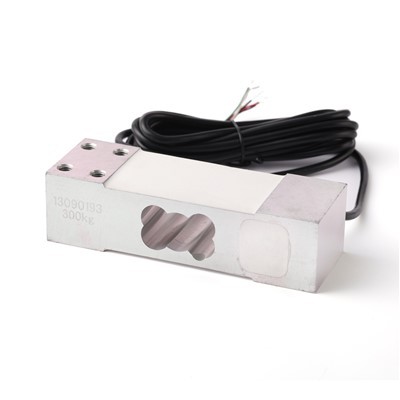


Parallel Beam Strain Gauge Load Cell
Model: SPA-02
Related Load: 3-100KG
Features:
Material: Alloy Aluminum, Colourless anodized; Small Size
High Precision OIML R60 standard, Long terms stability, economic load cells, easy to install
Applications: Pricing Scale, Electronic scales, Coffee machine, Platform scales etc.
Dimensions:

|
Related Load (KG) |
3-6 |
8-50 |
60-100 |
|
B |
20 |
30 |
40 |
|
Technical Parameters: |
|
|
Precision: |
C3 |
|
Rated Output: |
2mv/v±0.1 |
|
Creep(%F.S/30min): |
±0.02 |
|
Zero balance(%F.S): |
±1.0 |
|
Input resistance: |
405±10 |
|
Output resistance: |
350±3 |
|
Insulation resistance: |
≥5000(100VDC) |
|
Temp. effect on span(%F.S/10℃): |
±0.02 |
|
Temp. effect on zero(%F.S/10℃): |
±0.02 |
|
Use temp. range(℃): |
-20~+55 |
|
Excitation voltage(V): |
9~12(DC) |
|
Safety overload (%F.S) |
150% |
|
Defend grade |
IP65 |
|
Cable Length: |
0.45meters -2 meters |
|
Connection: |
Red (Input+), Black(Input-), |
For small capacity force measurement (typically grams up to ~50 kg), parallel beam load cells are often the superior choice over shear beams. Here's why, along with key details and applications:
Why Parallel Beam (vs. Shear Beam) for Small Capacities?
Higher Sensitivity: Parallel beams have a longer bending moment and thinner web(s), creating more strain under the same load. This generates a larger output signal (mV/V), crucial for accurately measuring tiny forces/weights.
Better Resolution: Linked to sensitivity, they can detect smaller increments within their capacity range.
Lower Profile: Their compact design fits easily into tight spaces common in small-scale equipment.
Optimized for Low Loads: Shear beams rely on significant shear stress, which is less pronounced at very low loads. Parallel beams excel at measuring bending stress, which scales effectively down to gram levels.
Key Design Features of Small Capacity Parallel Beam Load Cells:
Dual Flexure Design: Features two precisely machined, thin sections ("flexures" or "webs") where strain gauges are bonded. These flexures concentrate the bending stress.
Strain Gauge Placement: Gauges are bonded to the sides of the flexures, aligned with the beam's axis (0°), measuring bending strain directly. Typically configured in a full Wheatstone bridge (4 active gauges) for temperature compensation and sensitivity.
Materials:
Aluminum: Most common for small capacities (<5-10kg). Offers excellent elasticity, high sensitivity, and lower cost. Prone to creep if overloaded.
Stainless Steel: Used where higher corrosion resistance, hardness, or minimal creep is needed (e.g., medical, food). Slightly less sensitive than aluminum for the same capacity.
Mounting: Fixed at one end (base), load applied at the other end (load point). Requires rigid, flat mounting surfaces and proper hardware. Critical: Must be mounted with minimal side load or torsion.
Overload Protection: ESSENTIAL for small cells. Often incorporate mechanical stops within the housing to prevent damage from accidental overloads or shock.
Typical Applications for Small Capacity Parallel Beam Load Cells:
Precision Bench & Laboratory Balances: Analytical balances, microbalances, precision scales for labs, quality control, and research (grams to low kilograms).
Filling & Dosing Machines:
Small-head liquid fillers (pharma vials, cosmetics, reagents).
Powder micro-dosing (additives, spices, pharmaceuticals).
Capsule filling machines.
Checkweighers: High-precision checkweighers for small, valuable items (electronics components, pharmaceuticals, jewelry).
Force Measurement in Small Mechanisms:
Thrust measurement on small motors/actuators.
Tension/compression testing of small components (springs, wires, connectors).
Monitoring insertion forces (electrical connectors, medical devices).
Process Control Feedback: Precise force control in delicate assembly processes or robotic handling.
Medical Devices: Patient monitoring sensors, infusion pump feedback, rehabilitation equipment forces.
Jewelry & Precious Metals Scales: High-precision weighing of small, high-value items.
Pipette Calibration Systems: Measuring the force/dispense volume accuracy of pipettes.
Small Hopper/Bin Weighing: For precise ingredient addition in small batch processes.
Critical Advantages for Small Capacities:
High Accuracy & Repeatability: Excellent performance within their specified range.
Compact Size: Fits into space-constrained designs.
Cost-Effective: Relatively simple manufacturing for low capacities.
Good Long-Term Stability: When properly selected and protected.
Critical Limitations/Considerations:
Poor Off-Center Load Tolerance: THE BIGGEST DRAWBACK. Parallel beams are highly sensitive to the point of load application. Load must be applied precisely along the centerline of the load point. Off-center loads introduce significant errors (bending moments). Solution: Use load buttons/adapters and ensure excellent mechanical alignment. Not suitable for large platform scales unless multiple cells are used with complex lever systems (rare for small cap).
Lateral Load & Torsion Sensitivity: Can be easily damaged or give erroneous readings if subjected to side forces or twist. Requires careful mechanical design.
Limited Capacity: Performance degrades significantly above ~50-100 kg; shear beams become more practical.
Overload Vulnerability: Even minor overloads can permanently damage the thin flexures. Mechanical stops are mandatory.
Mounting Rigidity: The fixed end must be mounted to an extremely rigid base to prevent flexure and measurement errors.
Hot Tags: Parallel Beam Strain Gauge Load Cell for Platform Scale, China, manufacturers, suppliers, factory, made in China